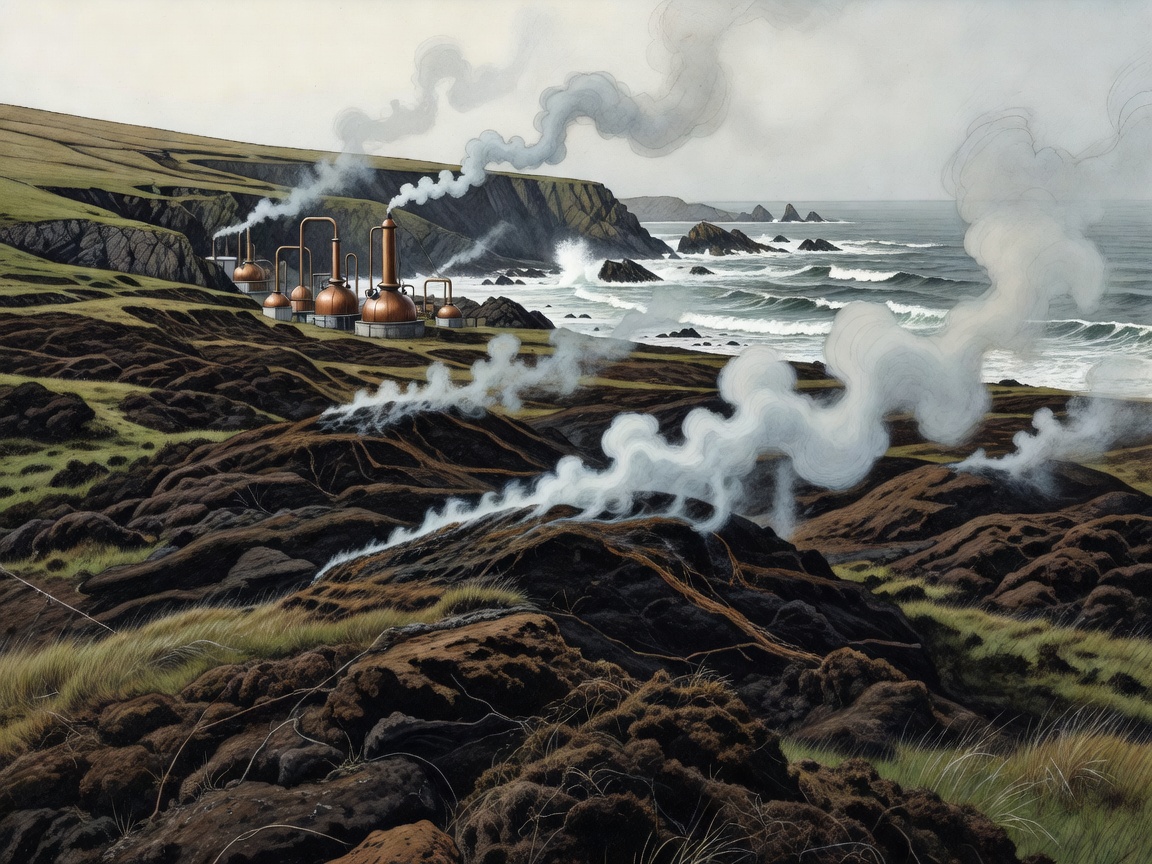
What makes Islay whisky recognisable?
Islay is an island in the Inner Hebrides with a long distilling tradition and a broad range of styles. Some Islay whiskies are heavily peated and smoky; others are lightly peated or unpeated. Coastal location may be part of the sensory story, but a salty flavour is not proof that seawater entered the spirit. Casks, fermentation and perception are doing more work than folklore usually admits.
Peat smoke can suggest medicinal, earthy, tarry, barbecue, mossy or ash-like notes. The peat’s botanical composition, where it was cut, how it was dried and how much smoke the malt received all matter. A label that says “peated” answers one question. It does not settle the argument.
How does peat enter the process?
During malting, germinating barley is dried with warm air. Burning peat in the kiln adds smoke to that air, depositing phenolic compounds on the barley. Peat level is measured and reported in ways that relate to malt, but the final whisky’s perceived smoke also depends on fermentation, distillation, cask influence and time.
Phenols can be softened or reshaped during maturation. A smoky new make in an active sweet cask may become a mixture of smoke, vanilla, fruit and spice. In a refill cask, the underlying distillate can remain more exposed. The sensible comparison is therefore between production and cask details, not between island photographs.
Does the coast make whisky salty?
Coastal warehouses and island air are frequently discussed alongside maritime character. Whisky matures in a complex environment, but the contribution of warehouse location is difficult to separate from spirit style, cask history and expectation. Do not treat “coastal” as a laboratory result. Treat it as context.
The more reliable clues are explicit: peat level when provided, fermentation style where disclosed, still shape, cask type, age and bottling strength. A whisky can taste briny to one person and smoky to another. Sensory language is useful, provided it remains a description rather than a scientific certificate.
Which casks suit smoky spirit?
Ex-bourbon oak often gives smoke room to speak while adding vanilla and sweetness. Sherry-seasoned casks can create a darker combination of dried fruit, spice and phenolic notes. Wine, port and other finishing casks may shift the balance again. Finishing periods vary, and a finish is not equivalent to full maturation in the second cask.
Heavy peat and active oak can make a forceful whisky. That may be deliberate, but it can also mask delicate fermentation or distillation character. Refill oak is often more revealing when the purpose is to understand the spirit rather than the cask’s decorating budget.
How should a label be read?
Look for the distillery name, age statement, strength, cask description and whether the whisky is single malt or blended. “Islay” identifies a protected geographical origin, not a required peat level. Independent bottling labels may provide more production detail, but terms and disclosures vary. Compare labels line by line before comparing tasting notes.
What is the useful takeaway?
Separate smoke from everything around it. Ask whether a note comes from peat, oak, fermentation or distillation. Islay is a particularly good region for learning that a powerful aroma can obscure several quieter decisions. Smoke is loud. It is not necessarily in charge.