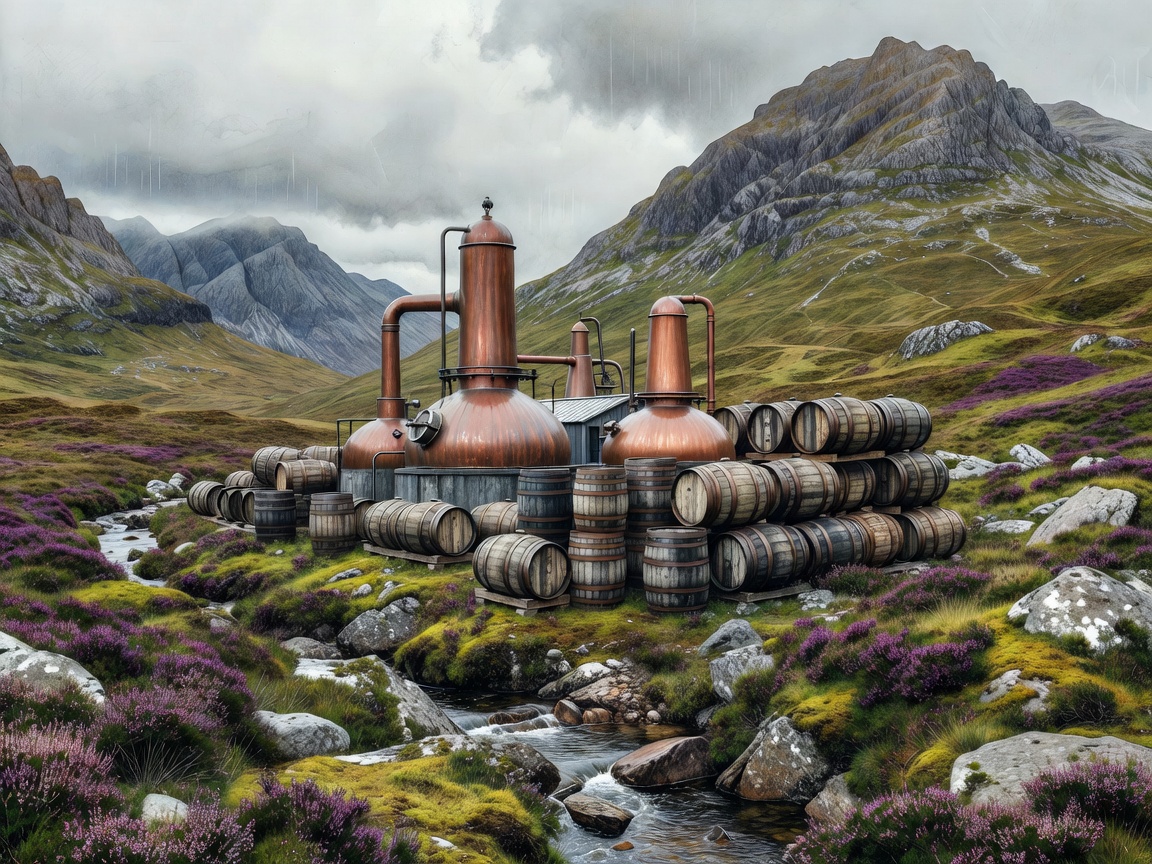
Why are Highland whiskies so difficult to summarise?
The Highland region covers a wide area north of the traditional Lowland boundary, excluding the islands that are commonly discussed separately. Its distilleries work with different water sources, barley supply chains, still shapes, fermentation choices and warehouse environments. A coastal Highland whisky and an inland Highland whisky may share a legal region while sharing little sensory vocabulary.
Descriptions such as heathery, honeyed, waxy, coastal, fruity or smoky can all be found in discussions of Highland spirit. None should be treated as a regional requirement. Geography provides context; it does not write the recipe.
What production choices matter most?
Fermentation is an important source of flavour and texture. Yeast converts sugars into alcohol and creates compounds that later contribute fruit, floral and cereal notes. Time, temperature, washback material and yeast management all affect the wash. Public labels rarely provide enough information to compare these variables directly, so tasting should be paired with the production details that are available.
Still design creates another set of differences. Height, shape, lyne-arm angle and heating method alter reflux and copper contact. More reflux generally gives a lighter spirit; less can preserve heavier compounds. The cut between spirit fractions also matters. Regional labels cannot capture those engineering decisions, which is why “Highland style” remains a loose phrase.
Does water define Highland whisky?
Water is essential for mashing, cooling and process cleaning, but its influence on the final flavour is often overstated. Treatment, source, process stage and dilution all matter. Local water can be part of a distillery’s history without acting as a simple flavour ingredient in the finished whisky.
Peat may enter through the water or the malt, but peat smoke is usually associated with drying malt rather than geography alone. Some Highland distilleries produce smoky whisky; many do not. Check the label and producer notes rather than guessing from a mountain-shaped logo.
How does maturation vary across the region?
Warehouse type, location, cask stock and spirit strength shape maturation. Drier or more exposed conditions may influence evaporation and extraction differently from sheltered inland warehouses, but the relationship is not a tidy formula. Cask history remains central: refill bourbon, first-fill bourbon, sherry-seasoned oak and wine casks each change the balance.
Age is useful but incomplete. A younger whisky in an active cask can show more oak than an older whisky in refill wood. A finish adds another layer and may be used to bring fruit, spice or sweetness to a spirit whose structure is already established.
How should you compare Highland bottles?
Divide the task into location, spirit and cask. First identify whether the whisky is coastal, inland or simply labelled Highland. Then consider weight, peat and texture. Finally inspect age, cask type, finishing language, strength and filtration information. This sounds methodical because it is. The Highlands have earned the inconvenience.
What does the region teach?
It teaches caution about labels. Highland whisky is not a flavour family so much as a large field of production choices. Use the region to narrow a search, then let still design, fermentation, peat and oak explain the bottle.